Sunday, October 13, 2013
Seminar Adolescent Idiopathic Scoliosis
San Juan De Dios Physical Medicine and Rehabilitation has a seminar today October 13 2013 on Adolescent Idiopathic Scoliosis. For those who attended you can download a copy of the first part of the lecture here it is in PDF format. Hope you learned something new.
Wednesday, July 31, 2013
ADD Ads Exercise at Home
Here in the Philippines, may it be at daytime or night time,
the major TV/Network channels have their way of luring viewers to watch. Their
technique is to have what they call “Telenovelas” or “Teleseryes”. People get
to be glued either in the afternoon or even during and after supper to watch
local or foreign (usually Korean) translated to tagalog series. Now why in all
of the topics I am covering this time has got to do with such series?
I usually see patients in the clinics wherein the relatives,
caregivers or even the patient themselves complain that home exercises taught
to them are not being done. Reasons usually range from there is no more time,
they are tired already, no one is able to monitor the exercise, or the home
exercises are too many.
My highly recommended time is then to add the exercises
during “telenovela” time.
How come? Since these major networks want to get your
viewing time, they will make you watch a 30 mins to an hour show BUT their
style is that they will have the “teleserye” show for around 4 to 5 mins and
then followed by a 4 to 5 minute set of advertisements ranging from 10 to 15
commercials. After which the cycle begins again. 5 mins show, 5 mins
advertisements until the show ends for the day. Then you will watch it again
the next day, Monday to Friday. Sure you can get glued to the show for the 5 minutes
but what do you do on the 5 minutes of advertisements?
My highly recommended activity, Add Ads Exercises at home!
Simply
stated, you add exercises during ads time. The set of exercises that are given
by the physical therapist can be done during the advertisement time. How many
times? Do 1 repetition of an exercise during 1 commercial. Once that particular
5 minutes is through, you have done 1 set of 10 to 15 reps of that exercise. On
the next set of advertisements, do another type of exercise or another set. By
the time you are finished with 1 show, you completed it. If you are glued the
whole night, then the more you have done your exercises.
Advantages:
1. It solved the no time to do it at home.
2. You won’t get tired. By doing 1 exercise per advertisement
which is around 10 to 15 seconds per advertisement most likely is not that
hard. And what else would you do to make your time more meaningful during those
commercial breaks.
3. Monitoring. The companion of the patient can be glued to
the show but during breaks can help out with the patient. It is a win-win
situation.
4. Too many exercises dispersed during the whole series of
shows made you enjoy your night in watching and at the same time been able to
do what is needed. What more can you ask for!
Conclusion:
Home exercises are given to help the patient
carry out the program even at home. But in order to make it easier, simpler and
even convenient is just by doing 1 rep of exercise per advertisement time. It
may be not enough to look on a short term goal but it will be meaningful in the
long term. As the saying goes, “One step at a time and you will get there
eventually”. In this case, Add 1 Ads
Exercise at a time and it will make you reach your goal at the convenience of your HOME!
Labels:
caregiver,
Home Exercise,
Physical Therapy,
Telenovela,
teleserye
Monday, January 30, 2012
Neurological and Functional Recovery: The Difference
Having a stroke is one of those medical conditions with a devastating effect on a person as well as for the family. I will not go into detail on this for this article but just to provide a general view a stroke is a medical/neurological condition wherein the brain gets injured due to sudden block of blood flow or due to rupture of a blood supply to it. The effect in terms of what happens to a person is generally affectation of the strength usually on the half side of the body. This is called hemiparesis(partial) or hemiplegia (complete) which is the paralysis of half of the body. i.e affectation of the left upper and left lower limb or vice versa.
Now just to give a rundown, the cost for medical treatment is definitely something of a blow to any family. It not only disrupts the savings of the family but it may also affect the income especially if the one affected is the breadwinner. Not only that, the family members who will skip work or go on leave also looses their productivity/earnings. Do I need to say more?
Now after the patient becomes stable and is discharged, the question now arises if how much did the patient recover? I will define first neurological recovery. I will simplify this, a patient prior to a stroke has a normal strength on both upper and lower limbs. A Normal grade is 5 over 5(5/5). When the patient has a stroke the left side as an example lost its strength and became poor (2/5). Not only that but also his sensation to touch on the left side decreased by 80 percent. The patient also had difficulty in speaking. All of the above findings show a neurological deficit. If after 4 days of treatment the patient regained his strength from poor (2/5) to fair (3/5), his sensation to light touch improved from 80% less to 50% now while his speech became normal. Those improvements are what we call neurological recovery. See table below.
As for functional recovery, it is the ability of the patient to do activities with or without neurological deficits. Using the example above the patient has initially been fully functional, working, typing, eating, dressing independently etc. He had a stroke wherein he has 2/5 strength, 80% sensory deficit and affected speech. So he became confined to bed, unable to go to the bathroom, feed himself etc. He became fully dependent. Now lets change the situation after 4 days. He still has the same deficit but he is now able to sit by himself, he is able to sit for 30 mins with minimal support, and now able to eat with partial assistance. He has recovered functionally even if his neurological deficit is still the same after 4 days. See table below.
Why am I pointing out these differences? It is because it is often thought that being unable to move a limb means one cannot adapt and become functional. There are patients who had superb neurological recovery as they can move the upper and lower limbs after a stroke and yet are in wheelchair and fully dependent in their activities. While those who have 2/5 lower limbs strength are now able to ambulate with a cane and do self care activities with minimal assistance.
CONCLUSION: The point I am driving is that the functional recovery on an individual is not based solely on the neurological recovery. By undergoing physical rehabilitation and with the proper motivation a patient can recover functionally even with a poor neurological recovery.
Now just to give a rundown, the cost for medical treatment is definitely something of a blow to any family. It not only disrupts the savings of the family but it may also affect the income especially if the one affected is the breadwinner. Not only that, the family members who will skip work or go on leave also looses their productivity/earnings. Do I need to say more?
Now after the patient becomes stable and is discharged, the question now arises if how much did the patient recover? I will define first neurological recovery. I will simplify this, a patient prior to a stroke has a normal strength on both upper and lower limbs. A Normal grade is 5 over 5(5/5). When the patient has a stroke the left side as an example lost its strength and became poor (2/5). Not only that but also his sensation to touch on the left side decreased by 80 percent. The patient also had difficulty in speaking. All of the above findings show a neurological deficit. If after 4 days of treatment the patient regained his strength from poor (2/5) to fair (3/5), his sensation to light touch improved from 80% less to 50% now while his speech became normal. Those improvements are what we call neurological recovery. See table below.
As for functional recovery, it is the ability of the patient to do activities with or without neurological deficits. Using the example above the patient has initially been fully functional, working, typing, eating, dressing independently etc. He had a stroke wherein he has 2/5 strength, 80% sensory deficit and affected speech. So he became confined to bed, unable to go to the bathroom, feed himself etc. He became fully dependent. Now lets change the situation after 4 days. He still has the same deficit but he is now able to sit by himself, he is able to sit for 30 mins with minimal support, and now able to eat with partial assistance. He has recovered functionally even if his neurological deficit is still the same after 4 days. See table below.
Why am I pointing out these differences? It is because it is often thought that being unable to move a limb means one cannot adapt and become functional. There are patients who had superb neurological recovery as they can move the upper and lower limbs after a stroke and yet are in wheelchair and fully dependent in their activities. While those who have 2/5 lower limbs strength are now able to ambulate with a cane and do self care activities with minimal assistance.
CONCLUSION: The point I am driving is that the functional recovery on an individual is not based solely on the neurological recovery. By undergoing physical rehabilitation and with the proper motivation a patient can recover functionally even with a poor neurological recovery.
Labels:
functional recovery,
Neurological recovery,
Stroke
Thursday, January 26, 2012
Importance of Physical Therapy
A local advertisment simply says it all, "Mahal ang magkasakit." (Getting sick is expensive). This is especially true for those who got hit by devastating or debilitating conditions such as strokes or similar conditions that affect the physical strength of a patient. Lets try to enumerate the would be expenses: Hospitalization, medicines, laboratory and imaging/diagnostice procedures, and profesional fees for physicians
Now comes the second part of the expenses, upon discharge of a patient and brought home its time to deal with the refitting of the residence to the present needs of the patient. Then one will include continuation of medicine, needed diagnostic test for monitoring and scheduled checkups with their physician.
Now why am I trying to enumerate all of these and yet the title is importance of Physical Therapy. Well simply stating it, a patient who is brought home and has lost the ability to be independent in activities of daily living (walking, dressing, eating, walking, bathing, working etc), needs assistance and caregiving. Which in order to achieve independence partial or complete, needs to undergo physical therapy. Now the other concern is, did physical therapy start while in the hospital or just an afterthought upon dischage?
Unfortunately, this is something that is not sometimes discussed to the patient/relatives and if by any chance discussed, may be considered as a miscellaneous expense and not a required expense. What am I pointing out? If a patient is asked to buy medicines and/or undergo physical therapy, what will the patient/relative do? The patient/relatives may opt to have both but oftentimes will opt to have the medicine and forego the physical therapy. The would be possible reasoning is, "Pwede naman yan pag lumabas na ng hospital" (That can be done already once the patient is discharged).
Again unfortunately, it may be initially less expensive if physical therapy is not done during confinement but how is it in the long run? An article done by Ruth M. Kleinpell, Kathcy Fletcher and Bonnie Jennings in Patient Safety and Quality: An Evidence-Based Handbook for Nurses pointed out the ff:
1. I quote " A dissonance exists between the hospital environment and therapeutic goal for the hospitalized elderly." (This means the goal is to make them medically stable but not functionally recovered upon discharge)
2. By Day 2 deconditioning and functional decline was evident on elderly individuals.
3. Elderly patients who was assessed during confinement showed that from day 2 to discharge, 67% showed no improvement and 10 percent showed further decline.
It then just shows that if an individual further declines in functional status that means, EXTRA care/assistance. Which is equivalent to a caregiver or nurse stay at home. If the patient is fully dependent you might need 2 caregivers in 1 duty shift. Or even to the point that the relative/love one would stop or not work in order to take care of the patient. That is lost productivity not only for the patient but also for the relative taking care of him/her.
And study shows that a deconditioned muscle (due to disuse or non use), needs 2 to 3 times the duration to be strengthened back to its original condition as compared to its deconditioning. So for example, the lower limbs lost its strength for 2 weeks of bedrest/immobility, it will need 4 to 6 weeks before it regains its former strength. And that is for young individuals, what more for elderly or those who became debilitated?
The Evidence Based Review of Stroke Rehabilitation (ESBSR), states that there is strong evidence that greater intensities of physiotherapy and occupational therapy resulted in improved functional outcomes after stroke. This then points to the fact that in the long run, which is the usual duration for those who have a stroke will benefit on early intervention to minimize potential prolonged bedridden and immobilization complications management. These complications, such as bedsores, pulmonary conditions, lower limb edema, joint stiffening, fully dependent on all activities, depression etc, may then prove more costly than having early intervention.
Table 1 shows the effect of prolonged bed rest. (click Table to enlarge)
*Source/Table were it was taken from is noted at end of article.
Conclusion: Patients who had debilitating conditions that affect their functional status during confinement should be assessed properly if early physical therapy intervention is needed or not. Talk to your attending physician so that the recommended Physical Medicine and Rehabilitation specialist can discuss and provide the benefits and consequences or early physical/occupational therapy. Know your options so that you can decide on what would be more beneficial for the patient as well as for the love ones.
* Ruth M. Kleinpell, Kathcy Fletcher and Bonnie Jennings in Patient Safety and Quality: An Evidence-Based Handbook for Nurses
Next article would be the difference between neurological and functional recovery.
Now comes the second part of the expenses, upon discharge of a patient and brought home its time to deal with the refitting of the residence to the present needs of the patient. Then one will include continuation of medicine, needed diagnostic test for monitoring and scheduled checkups with their physician.
Now why am I trying to enumerate all of these and yet the title is importance of Physical Therapy. Well simply stating it, a patient who is brought home and has lost the ability to be independent in activities of daily living (walking, dressing, eating, walking, bathing, working etc), needs assistance and caregiving. Which in order to achieve independence partial or complete, needs to undergo physical therapy. Now the other concern is, did physical therapy start while in the hospital or just an afterthought upon dischage?
Unfortunately, this is something that is not sometimes discussed to the patient/relatives and if by any chance discussed, may be considered as a miscellaneous expense and not a required expense. What am I pointing out? If a patient is asked to buy medicines and/or undergo physical therapy, what will the patient/relative do? The patient/relatives may opt to have both but oftentimes will opt to have the medicine and forego the physical therapy. The would be possible reasoning is, "Pwede naman yan pag lumabas na ng hospital" (That can be done already once the patient is discharged).
Again unfortunately, it may be initially less expensive if physical therapy is not done during confinement but how is it in the long run? An article done by Ruth M. Kleinpell, Kathcy Fletcher and Bonnie Jennings in Patient Safety and Quality: An Evidence-Based Handbook for Nurses pointed out the ff:
1. I quote " A dissonance exists between the hospital environment and therapeutic goal for the hospitalized elderly." (This means the goal is to make them medically stable but not functionally recovered upon discharge)
2. By Day 2 deconditioning and functional decline was evident on elderly individuals.
3. Elderly patients who was assessed during confinement showed that from day 2 to discharge, 67% showed no improvement and 10 percent showed further decline.
It then just shows that if an individual further declines in functional status that means, EXTRA care/assistance. Which is equivalent to a caregiver or nurse stay at home. If the patient is fully dependent you might need 2 caregivers in 1 duty shift. Or even to the point that the relative/love one would stop or not work in order to take care of the patient. That is lost productivity not only for the patient but also for the relative taking care of him/her.
And study shows that a deconditioned muscle (due to disuse or non use), needs 2 to 3 times the duration to be strengthened back to its original condition as compared to its deconditioning. So for example, the lower limbs lost its strength for 2 weeks of bedrest/immobility, it will need 4 to 6 weeks before it regains its former strength. And that is for young individuals, what more for elderly or those who became debilitated?
The Evidence Based Review of Stroke Rehabilitation (ESBSR), states that there is strong evidence that greater intensities of physiotherapy and occupational therapy resulted in improved functional outcomes after stroke. This then points to the fact that in the long run, which is the usual duration for those who have a stroke will benefit on early intervention to minimize potential prolonged bedridden and immobilization complications management. These complications, such as bedsores, pulmonary conditions, lower limb edema, joint stiffening, fully dependent on all activities, depression etc, may then prove more costly than having early intervention.
Table 1 shows the effect of prolonged bed rest. (click Table to enlarge)
*Source/Table were it was taken from is noted at end of article.
Conclusion: Patients who had debilitating conditions that affect their functional status during confinement should be assessed properly if early physical therapy intervention is needed or not. Talk to your attending physician so that the recommended Physical Medicine and Rehabilitation specialist can discuss and provide the benefits and consequences or early physical/occupational therapy. Know your options so that you can decide on what would be more beneficial for the patient as well as for the love ones.
* Ruth M. Kleinpell, Kathcy Fletcher and Bonnie Jennings in Patient Safety and Quality: An Evidence-Based Handbook for Nurses
Next article would be the difference between neurological and functional recovery.
Labels:
Bedridden,
decondition,
immobility,
Physical Therapy,
PT,
Stroke
Sunday, November 27, 2011
Runner's Feet Seminar Presentation
Just today, I had the opportunity to share my insights on a seminar conducted in San Juan De Dios Hospital in Pasay. The topic is Runner's Feet. I was given the task to share about the anatomy of the shoe as well as the biomechanics of the foot that affect an individual during running. It also included some history of the running shoe as well as the evolution of the shoe.So as promised to the attendees, I am providing a link to the presentation slides for your own personal use. As I have mentioned, with so much paper used, I went the paperless route and hopefully you just place this in your electronic device, (ipad,computer,smartphone) and minimize the unnecessary use of paper if you can store it digitally and electronically.
By the way, I will make this available for download for only the month of December 2011. After which I will remove it already. So make sure you get it and save it before the end of the year. It is in pdf file already.
Enjoy and here is the link. Just click on it. Does the shoe "feet"? presentation
Friday, October 14, 2011
Falls in the elderly: Exercises done at home
Your patients or love ones who have been not so active at home will succumb sooner or later to the what we call deconditioning. Due to their condition such as poor balance or affected by other ailments, they become confined in bed, or wheelchair or chair. Definitely such situations will leave their upper and lower limbs weaker. As the saying goes, "Use it or lose it."
So here are some simple exercises that you can ask your patient or love one to do at home. We will start with some exercises for the upper limbs done during sitting.
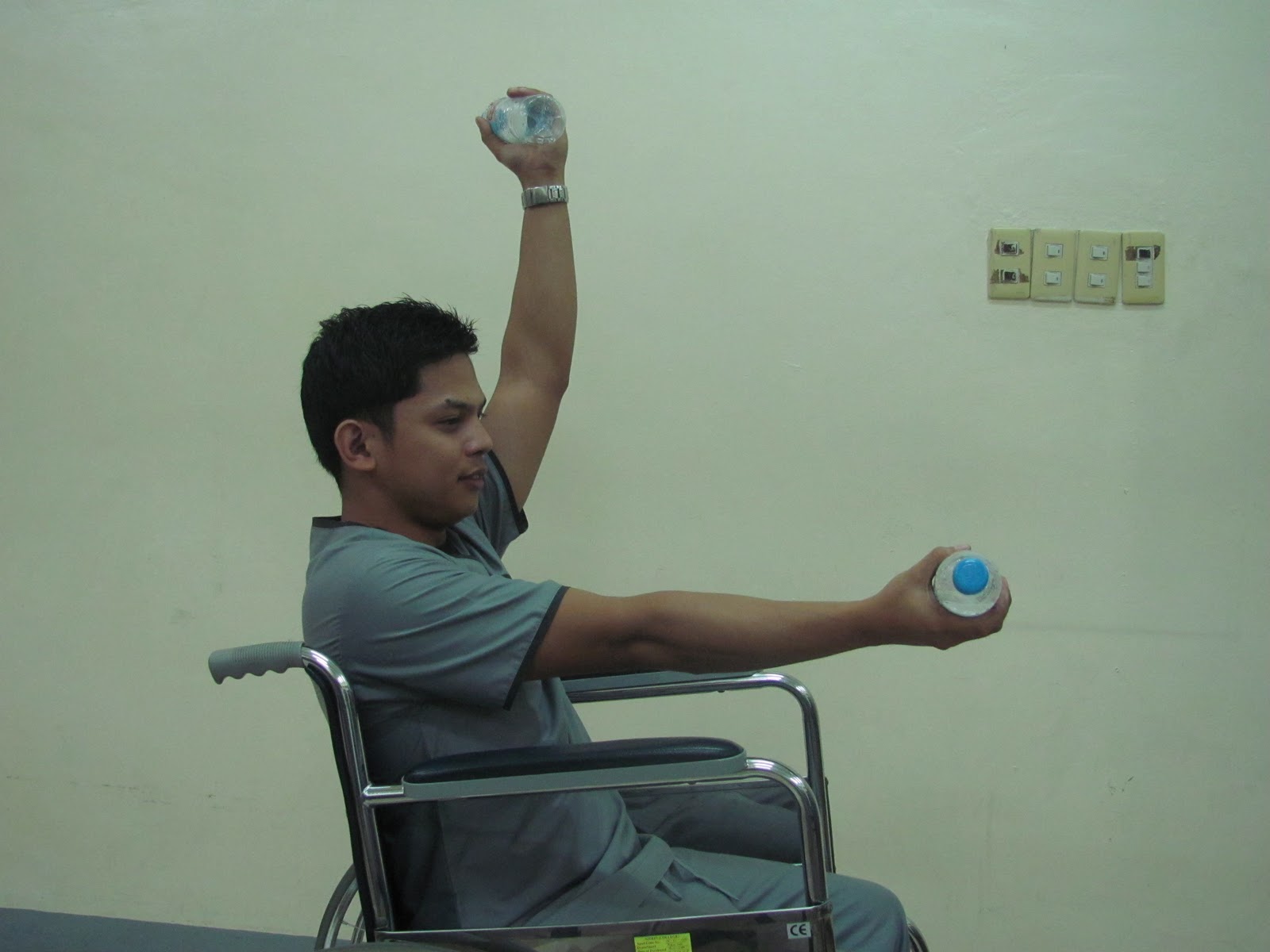
1. Forward Arm lift
While the patient is sitted. Make the patient do an arms forward position. Then let the patient lift the arms alternately beyond the head level or as high as they can go. Just make sure the patient breathes in and out while doing the exercise. Do not make them hold their breath.
Do this without or with weights being held on the hand depending on the patients capability.
2. Backward pull exercise
Again patient in an arms forward position and then let the person imagine as if pulling a stick backward. This can be done with or without weights or even holding a stick. Remind the person to just breath in on starting position and breath out during pull position. Do not make them hold their breath.
3. Shoulder shrugs
Let the person keep the arms and hands on the side (with or without weights) and then let the person shrug the shoulders. Breath in during starting position and breath out on shrug position.
Reasons of doing this?
1. To keep the upper limb in good condition or at the least not deteriorate its strength.
2. Keep the joints moving and not become stiff
3. Strengthen the muscles that help the person stand during pull up to stand as well as keep the tone of the upper back muscles.
4. Prevent stooping forward during sitting.
How many times to be done?
Depending on the condition of the patient, you can start at 10 counts per exercise and progress accordingly.
It is advised to do it 3 times a day, morning, afternoon and early evening.
Extra Tip:
The simpliest weight you can use are just plastic water bottles. A 250ml water bottle is equivalent to 1/4th kg. (100ml water is equivalent to 100gms) So no need to buy gym weights.
The next set will be standing exercises.
Special Thanks to Mr. Jayson Javier, PTRP. Upon this blog post, he is a PT faculty instructor in The College of Physical Therapy of San Juan De Dios Educational Foundation, Incorporated, Pasay City.
So here are some simple exercises that you can ask your patient or love one to do at home. We will start with some exercises for the upper limbs done during sitting.
1. Forward Arm lift
Do this without or with weights being held on the hand depending on the patients capability.
2. Backward pull exercise
Again patient in an arms forward position and then let the person imagine as if pulling a stick backward. This can be done with or without weights or even holding a stick. Remind the person to just breath in on starting position and breath out during pull position. Do not make them hold their breath.
| Arms forward starting position |
| Backward pull position |
3. Shoulder shrugs
Let the person keep the arms and hands on the side (with or without weights) and then let the person shrug the shoulders. Breath in during starting position and breath out on shrug position.
| Shoulder shrug starting position |
| Shoulder Shrug up position |
Reasons of doing this?
1. To keep the upper limb in good condition or at the least not deteriorate its strength.
2. Keep the joints moving and not become stiff
3. Strengthen the muscles that help the person stand during pull up to stand as well as keep the tone of the upper back muscles.
4. Prevent stooping forward during sitting.
How many times to be done?
Depending on the condition of the patient, you can start at 10 counts per exercise and progress accordingly.
It is advised to do it 3 times a day, morning, afternoon and early evening.
Extra Tip:
The simpliest weight you can use are just plastic water bottles. A 250ml water bottle is equivalent to 1/4th kg. (100ml water is equivalent to 100gms) So no need to buy gym weights.
The next set will be standing exercises.
Special Thanks to Mr. Jayson Javier, PTRP. Upon this blog post, he is a PT faculty instructor in The College of Physical Therapy of San Juan De Dios Educational Foundation, Incorporated, Pasay City.
Labels:
decondition,
Elderly,
Exercise,
immobility,
Sitting exercises,
Strengthening,
UE,
Upper limb
Sunday, September 25, 2011
Falls in the elderly: Prevention
Now we will deal with simple things in the household to prevent accidents that may lead the elderly people to lose balance. Also included are some things to consider to do when you have them checked by their physician.
Here in the Philippines, it usually have an extended type of family structure which of course consists of the grandparents or older population. So what are those simple steps to consider.
1. Keep the wires off the floor.
Usually extension cords, phone wires or internet wires, appliance wires criss-cross all over our houshold. It is thus obvious that the foot of an individual may be snagged while crossing over these wires.
2. Make sure rugs or floor mats will not cause snagging of the foot. If this is not kept flat off the floor then again catching the foot while crossing over it is very highly likely.
3. Make sure the floors are not slippery. We should reconsider if waxing and making the floor too shiny is not a potential fall factor for the elderly.
4. Use of non-skid shoes/slippers.
5. Use of night light in bedroom, stair lights. For some general "phenomenon" the elderly usually do not want to open lights going to the bathroom when they wake up at night. Again this is a potential risk for falls due to a) less ability to see in the dark b)balance and equilibrum problems c)weaker lower/upper limbs
6. Use of bedside commode instead of going to the bathroom during night time.
7. As for stairs, make sure there is contrasting colors of the steps and wall in order for them to discern the steps and not get confused or have a misstep.
8. Have their eyes checked. If only 1 eye is really able to see. i.e. cataract on 1 eye causing less vision, the depth perception of the individual is compromised.
9. Polypharmacy: Elderly individuals usually have a LOT of meds to take in the morning, lunch, evening and even in between. So try to visit their physician and ask what can be reduced or removed if possible. The potential for cross interactions is very high for multiple medicine intake that may affect their balance.
Alright, now the next blog will be some exercises that can help out the elderly. Stay tuned.
* Picture c/o MS online clipart from Fotolia
Here in the Philippines, it usually have an extended type of family structure which of course consists of the grandparents or older population. So what are those simple steps to consider.
1. Keep the wires off the floor.
| Tangled wires |
2. Make sure rugs or floor mats will not cause snagging of the foot. If this is not kept flat off the floor then again catching the foot while crossing over it is very highly likely.
3. Make sure the floors are not slippery. We should reconsider if waxing and making the floor too shiny is not a potential fall factor for the elderly.
4. Use of non-skid shoes/slippers.
5. Use of night light in bedroom, stair lights. For some general "phenomenon" the elderly usually do not want to open lights going to the bathroom when they wake up at night. Again this is a potential risk for falls due to a) less ability to see in the dark b)balance and equilibrum problems c)weaker lower/upper limbs
6. Use of bedside commode instead of going to the bathroom during night time.
7. As for stairs, make sure there is contrasting colors of the steps and wall in order for them to discern the steps and not get confused or have a misstep.
8. Have their eyes checked. If only 1 eye is really able to see. i.e. cataract on 1 eye causing less vision, the depth perception of the individual is compromised.
9. Polypharmacy: Elderly individuals usually have a LOT of meds to take in the morning, lunch, evening and even in between. So try to visit their physician and ask what can be reduced or removed if possible. The potential for cross interactions is very high for multiple medicine intake that may affect their balance.
Alright, now the next blog will be some exercises that can help out the elderly. Stay tuned.
* Picture c/o MS online clipart from Fotolia
Labels:
Commode,
Elderly,
Falls,
Polypharmacy,
Prevention
Tuesday, September 20, 2011
Falls in the elderly: The Facts
As I have discussed in the past 2 blogs regarding falls in the elderly that are focused mainly on simple ways to assess if they have a tendency to fall. Now you may be wondering, what is the big deal with falling?
Short answer. A LOT!
Long Answer: As one ages, just like a mechanical equipment, the body undergoes "wear and tear" if I may simply it. Anatomically and physiologically, the body may not be able to handle circumstances as compared to when it was younger. Thus any trauma or accidents such as a fall may be too much to handle.
So now with the facts.
1. Elderly falls that resulted in fractures usually affect the wrist, spine and hip. 90% of those occur in the hip. The effect of course will be immobility leading more to physical deterioration. *
2. Elderly falls is 10x more likely to be hospitalized and 8x more likely to die as compared to children. *
3. 2x longer hospitalization with increased risk for home care. *
3. Increasing age also has increasing mortality (death) due to falls. *
4. Common injuries that occur in elderly falls, Head trauma, fractures as mentioned above, dislocations or soft tissue injuries. *
* Statistics and facts taken from article of George Fuller, COL, MC, USA in his article in American Family Physician.
So now that the facts are stated, one can now understand why elderly falls can be devastating to the one affected and to their love ones. Is this preventable. The short answer is "Yes". That will be the next set of topics. Stay tuned.
Short answer. A LOT!
Long Answer: As one ages, just like a mechanical equipment, the body undergoes "wear and tear" if I may simply it. Anatomically and physiologically, the body may not be able to handle circumstances as compared to when it was younger. Thus any trauma or accidents such as a fall may be too much to handle.
So now with the facts.
1. Elderly falls that resulted in fractures usually affect the wrist, spine and hip. 90% of those occur in the hip. The effect of course will be immobility leading more to physical deterioration. *
2. Elderly falls is 10x more likely to be hospitalized and 8x more likely to die as compared to children. *
3. 2x longer hospitalization with increased risk for home care. *
3. Increasing age also has increasing mortality (death) due to falls. *
4. Common injuries that occur in elderly falls, Head trauma, fractures as mentioned above, dislocations or soft tissue injuries. *
* Statistics and facts taken from article of George Fuller, COL, MC, USA in his article in American Family Physician.
So now that the facts are stated, one can now understand why elderly falls can be devastating to the one affected and to their love ones. Is this preventable. The short answer is "Yes". That will be the next set of topics. Stay tuned.
Labels:
American Family Physician,
Elderly,
Falls,
Fractures,
George Fuller
Monday, September 12, 2011
Falls in the elderly: How to assess their balance Part 2
The next part of these series of blogs for the elderly is another type of test that does not involve walking.
It is called the Four Test Balance Scale. A study done by Melinda Gardner, David Buchner, M. Clare Robertson and A. John Campbell from the Journal Age and Ageing 2001: 30: 77-83, Titled Practical implementation of an exercise-based falls prevention programme, showed how to do this test.
It requires an individual to stand on 4 different foot positions of increasing difficulty without an assistive device. The one being assessed can be helped out to assume the position but no help can be provided once the test starts per position.
The sequen
ce of the tests are:
1. Standing Feet together
2. Standing Semi-tandem (one foot is halfway in front of the other but still close together)
3. Standing Tandem position (one foot is in front of the other with the heel of the front foot touching the toe of the back foot)
4. One leg standing (One tested chooses which leg to stand on)
Picture reference was taken from the Journal mentioned above. Click on the link. (PDF file)
Each test should be completed for at least 10 seconds. Inability to assume or maintain that position is equivalent to a failed test stage. The one being tested should also be on bare feet.
Unlike the initial Timed "Up and Go" test which includes walking, this test is only done in a standing position. Again this give you an idea if your elderly love one already has possible problems in balance that need to be assessed by your family physician or your Physical Medicine and Rehabilitation Specialist.
For those who like to view a video of this test, it can be seen at Vimeo. However I believe it is in German language but at least you know how it is done.
It is called the Four Test Balance Scale. A study done by Melinda Gardner, David Buchner, M. Clare Robertson and A. John Campbell from the Journal Age and Ageing 2001: 30: 77-83, Titled Practical implementation of an exercise-based falls prevention programme, showed how to do this test.
It requires an individual to stand on 4 different foot positions of increasing difficulty without an assistive device. The one being assessed can be helped out to assume the position but no help can be provided once the test starts per position.
The sequen
ce of the tests are:1. Standing Feet together
2. Standing Semi-tandem (one foot is halfway in front of the other but still close together)
3. Standing Tandem position (one foot is in front of the other with the heel of the front foot touching the toe of the back foot)
4. One leg standing (One tested chooses which leg to stand on)
Picture reference was taken from the Journal mentioned above. Click on the link. (PDF file)
Each test should be completed for at least 10 seconds. Inability to assume or maintain that position is equivalent to a failed test stage. The one being tested should also be on bare feet.
Unlike the initial Timed "Up and Go" test which includes walking, this test is only done in a standing position. Again this give you an idea if your elderly love one already has possible problems in balance that need to be assessed by your family physician or your Physical Medicine and Rehabilitation Specialist.
For those who like to view a video of this test, it can be seen at Vimeo. However I believe it is in German language but at least you know how it is done.
Friday, September 9, 2011
Falls in the Elderly: How to Assess their Balance Part 1
Last August 2011, I was asked to give a short seminar on fall prevention in the elderly by Home Health Care. It gave me a chance to provide information on helping the allied medical and medical audience together with caregivers on taking care of the elderly. So to start this set of blogs, I initially asked myself, if I am taking care of someone in this age group, how can I know if he or she has problems in balance or mobility?
George F. Fuller, COL, MC, USA from White House Medical Clinic, Washington D.C. provided an article under American Family Physician that one way to screen the elderly is by noting if they have a history of fall within the last 6 months. If an elderly has more than 2x of occurrence of fall within 6 months an evaluation is warranted for any possible underlying problem. This may already denote a declining physical and physiological status.
Now if you like to test the mobility of an elderly, an easy way to do it is the Timed "Up and Go" Test. Wherein an individual is timed from doing this test. The patient sits on a standard armchair, stands up and walks for 3 meters (10 feet), turns around and return to a sitting position.

The individual is freely mobile if done in < 10 seconds; mostly independent if done within 11 to 20 seconds; Variable mobility if within 20 to 30 seconds and Impaired mobility if > 30 seconds. This will help you gauge if your elderly patient or love one has impaired mobility already.
Reference for Timed "Up and Go" Test is found on Table 6 of the link from Sir George Fuller's article under American Family Physician. (Click on the link above)
Next topic will be another way to test standing balance.
George F. Fuller, COL, MC, USA from White House Medical Clinic, Washington D.C. provided an article under American Family Physician that one way to screen the elderly is by noting if they have a history of fall within the last 6 months. If an elderly has more than 2x of occurrence of fall within 6 months an evaluation is warranted for any possible underlying problem. This may already denote a declining physical and physiological status.
Now if you like to test the mobility of an elderly, an easy way to do it is the Timed "Up and Go" Test. Wherein an individual is timed from doing this test. The patient sits on a standard armchair, stands up and walks for 3 meters (10 feet), turns around and return to a sitting position.
The individual is freely mobile if done in < 10 seconds; mostly independent if done within 11 to 20 seconds; Variable mobility if within 20 to 30 seconds and Impaired mobility if > 30 seconds. This will help you gauge if your elderly patient or love one has impaired mobility already.
Reference for Timed "Up and Go" Test is found on Table 6 of the link from Sir George Fuller's article under American Family Physician. (Click on the link above)
Next topic will be another way to test standing balance.
Labels:
American Family Physician,
Balance,
Elderly,
Falls,
George Fuller,
Timed Up and Go,
TUG
Monday, December 1, 2008
EMG-NCV Electomyography Nerve conduction Velocity study: Do you need one?
Your physician might recommend you undergo EMG-NCV study and you are wondering what it is. The simplest but not that accurate way of explaining it to my patients is by doing an analogy of this test with ECG or electocardiogram. ECG is the placement of electrodes on the chest which gets the electrical activity of the heart. It then helps the physician diagnose problems related to the electrical function of the heart. As for EMG-NCV it also tests the electrical function of either the nerve, the muscle or the junction between nerve-muscle. But the analogy actually ends there.
EMG-NCV is generally broken down into 2 parts.
1. The NCV test wherein electrodes or wires are placed on specific parts of the body depending on what nerve to test. Then a small probe that stimulates the nerve is initiated in order to see how fast or how slow the nerve traveled from the point of stimulation up to the point where the wires are placed. Usually more than one nerve is tested and may require comparison with the other side.
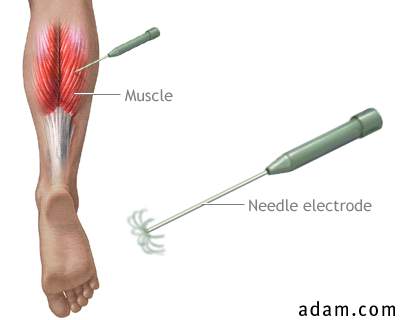
2. The EMG test is using a hairlike size needle that is attached to a computer. The needle is then inserted into the particular muscle that needs to be tested. Sort of an injection needle being inserted into your skin. The needle is then left there to see the electrical activity or any abnormalities that can be seen during the procedure. A youtube video by dsbgd011 shows this procedure found here.

Pictures as reference are taken from monarch diagnostic website.
The website link also explain this test.
Do you need one?
Usually this could be recommended if the nerve affected is the one coming out from the spine(back) and goes to the periphery (either to the hands or feet) called the peripheral nerve. If the nerve being tested is the spinal cord itself or the brain which is medically the central nervous system, then this test might not be beneficial.
So what specific conditions can EMG-NCV be recommended?
Back or neck pains that consider an impingement of the nerves, weakness of muscles of the upper and lower limbs that suspects a compromised peripheral nerve. Some of this are carpal tunnel syndromes, brachial plexus injuries or lumbar/cervical radiculopathies. EMG-NCV can also be recommended on some systemic conditions such as diabetic neuropathies or Guillane Barre syndromes. Facial nerve problems or trigeminal neuralgias are some conditions also that EMG-NCV can be used.
If an MRI or an imaging study is already done, would you still need this test? What is the difference?
Imaging studies usually will show the picture of the area where the suspected problem is but that is all it will tell the physician. EMG-NCV supplements that by telling the physician the function or electrical physiology of the suspected nerve/muscle. It can help the physician know if the problem is recent, an old one and how severe it is.
So if you need one, I hope this helps out in explaining the procedure.
EMG-NCV is generally broken down into 2 parts.
2. The EMG test is using a hairlike size needle that is attached to a computer. The needle is then inserted into the particular muscle that needs to be tested. Sort of an injection needle being inserted into your skin. The needle is then left there to see the electrical activity or any abnormalities that can be seen during the procedure. A youtube video by dsbgd011 shows this procedure found here.
Pictures as reference are taken from monarch diagnostic website.
The website link also explain this test.
Do you need one?
Usually this could be recommended if the nerve affected is the one coming out from the spine(back) and goes to the periphery (either to the hands or feet) called the peripheral nerve. If the nerve being tested is the spinal cord itself or the brain which is medically the central nervous system, then this test might not be beneficial.
So what specific conditions can EMG-NCV be recommended?
Back or neck pains that consider an impingement of the nerves, weakness of muscles of the upper and lower limbs that suspects a compromised peripheral nerve. Some of this are carpal tunnel syndromes, brachial plexus injuries or lumbar/cervical radiculopathies. EMG-NCV can also be recommended on some systemic conditions such as diabetic neuropathies or Guillane Barre syndromes. Facial nerve problems or trigeminal neuralgias are some conditions also that EMG-NCV can be used.
If an MRI or an imaging study is already done, would you still need this test? What is the difference?
Imaging studies usually will show the picture of the area where the suspected problem is but that is all it will tell the physician. EMG-NCV supplements that by telling the physician the function or electrical physiology of the suspected nerve/muscle. It can help the physician know if the problem is recent, an old one and how severe it is.
So if you need one, I hope this helps out in explaining the procedure.
Labels:
EMG,
muscle,
NCV,
Nerve,
peripheral neuropathy
Saturday, March 22, 2008
What is a Physiatrist?
Since, Physical Medicine and Rehabilitation is a specialty that was created during the near end of world war 2 era, not all are familiar with it. Unlike a cardiologist or dermatologist, a layman automatically knows what the doctor is specializing.
So as a way to give clarity as to what a Physical Medicine and Rehabilitation (PM&R) specialist or Physiatrist treats, I have placed links that will help out in explaining it.
The Association of Academic Physiatrists have a particular segment in explaining well on "What is a Physiatrist?" For those who like to view it in Flash player click here. The first few slides show the scope of the specialty. However, the later slides are more for medical students in the USA who are interested in taking this specialty. So you may skip that.
For those of you who has an ailment that is giving you some form of physical disability, Physical Rehabilitation assessment and management can help out. This is then the blog for you.
So as a way to give clarity as to what a Physical Medicine and Rehabilitation (PM&R) specialist or Physiatrist treats, I have placed links that will help out in explaining it.
The Association of Academic Physiatrists have a particular segment in explaining well on "What is a Physiatrist?" For those who like to view it in Flash player click here. The first few slides show the scope of the specialty. However, the later slides are more for medical students in the USA who are interested in taking this specialty. So you may skip that.
For those of you who has an ailment that is giving you some form of physical disability, Physical Rehabilitation assessment and management can help out. This is then the blog for you.
Thursday, March 13, 2008
Painful, Inflamed or Both? What medications to use.
Are pain medications the same with anti-inflammatory medications? Should one be used instead of the other? Can they be used interchangeably? Can they be used at the same time?
Conclusion:
First off, pain medications get a bad publicity both in the media and in the movies. You usually see stars or news on patients getting addicted to it. This is a sad faith for such useful medications. In reality, there are many types of pain medications, it is generally classified as “Analgesics” but from it stems various subtypes with each specific effect. This will range from the very basic such as acetaminophen or what we call paracetamol to the more advanced medications such as opiods. The opiods are the “addicting” medications portrayed in the media. If used accordingly and through a physician’s guidance, its medical importance is undeniable.
However, in most cases patients get pain medications mixed up with another subtype or kind, the anti-inflammatory medications or NSAID (non-steroidal anti-inflammatory drugs). From the term itself, anti-inflammatory medications are used on a condition that warrants control and abating inflammatory processes. In my previous article, acute inflammation is “usually” obvious to the naked eye. This is not the case if the inflammatory process is found deep within. Muscle, nerves or even ligaments or bone that are found in the inner layers of the limb may still be inflamed even if there is no warmth nor swelling outside. The patient only notices pain on certain positions or movements. One added benefit of anti-inflammatory medications is that it has a pain reliever effect too.
When patients tell their medication history, it is often only pain relievers. The pain goes away but after the effect of the medication subsides, they complain again. So they usually state that the medication is not working or useless. It is actually working but the cause of the pain is not addressed. Anti-inflammatory medications should then be used instead.
These are the common generic “Over the Counter” (OTC) pain medications in the Philippine drugstore:
1. paracetamol or acetaminophen
2. Mefenamic acid.
Brands such as Tylenol or Biogesic are Paracetamol base while Ponstan is mefenamic acid.
The anti-inflammatory medications that are over the counter are Ibuprofen found in Advil, or in the US, it is Motrin. Another one that recently became OTC is Flanax or Naproxen its generic name.
Some combine the two (Ibuprofen+paracetamol) such as Alaxan and Restolax. Its purpose is to combine the effect of removing the inflammation at the same time further relieve the pain while minimizing the usual side effect of gastric (stomach) irritation peculiar for anti-inflammatory medications.
So can your physician combine the two? Generally yes especially if the pain is too much. However, if your physician feels it can be taken care off by only one, then that would be 1 less medication to take.
Unfortunately, here in the Philippines, most of us like to take the advice given by a “friend” or “neighbor” who used this certain medication for his painful joint. Please be careful on such recommendations. This might not be the best drug for you and might end up making it worse. Consult your physician please.
When patients tell their medication history, it is often only pain relievers. The pain goes away but after the effect of the medication subsides, they complain again. So they usually state that the medication is not working or useless. It is actually working but the cause of the pain is not addressed. Anti-inflammatory medications should then be used instead.
These are the common generic “Over the Counter” (OTC) pain medications in the Philippine drugstore:
1. paracetamol or acetaminophen
2. Mefenamic acid.
Brands such as Tylenol or Biogesic are Paracetamol base while Ponstan is mefenamic acid.
The anti-inflammatory medications that are over the counter are Ibuprofen found in Advil, or in the US, it is Motrin. Another one that recently became OTC is Flanax or Naproxen its generic name.
Some combine the two (Ibuprofen+paracetamol) such as Alaxan and Restolax. Its purpose is to combine the effect of removing the inflammation at the same time further relieve the pain while minimizing the usual side effect of gastric (stomach) irritation peculiar for anti-inflammatory medications.
So can your physician combine the two? Generally yes especially if the pain is too much. However, if your physician feels it can be taken care off by only one, then that would be 1 less medication to take.
Unfortunately, here in the Philippines, most of us like to take the advice given by a “friend” or “neighbor” who used this certain medication for his painful joint. Please be careful on such recommendations. This might not be the best drug for you and might end up making it worse. Consult your physician please.
Conclusion:
Pain medications address only the pain and not the cause. If it is inflamed then,
anti-inflammatory medication should be used.
If over the counter (OTC) drugs such as those mentioned above do not work after a day or two, consult your nearest physical medicine and rehabilitation specialist.
Do NOT self medicate based on the advise of a non-physician.
Combining both (pain and anti-inflammatory) medications can be done especially if the pain is too much to handle by the patient.
anti-inflammatory medication should be used.
If over the counter (OTC) drugs such as those mentioned above do not work after a day or two, consult your nearest physical medicine and rehabilitation specialist.
Do NOT self medicate based on the advise of a non-physician.
Combining both (pain and anti-inflammatory) medications can be done especially if the pain is too much to handle by the patient.
Labels:
Inflammation,
Medications,
Over the counter,
Pain
Sunday, March 9, 2008
Cold or Hot? What should I use after a soft tissue injury?
This past week in the clinics, I was surprised to see patients in succession who attained sports injuries while playing. From an ankle sprain to muscle strains. What strike me the most, is that their first aid during the acute stage or within 24 to 48 hours after the injury is the application of heat on that area. The result is a more swollen and painful injured limb.
The rule of thumb for first aid in sports injuries or injuries sustained from a hard bump is to apply the RICE principle. RICE is the acronym for (R)est, (I)ce, (C)ompression, (E)levation on the affected area. Our body automatically reacts to the trauma it sustained (i.e. ankle landed unevenly on the floor causing an inversion injury) by making the area more swollen, reddish and warm or hot to touch. In worse cases, you see hematoma formation or blood clotting.
Now why (I)ce? Its effect upon application is that cold causes the blood vessels to constrict (become smaller). This then limits the amount of fluid to go out to the area and cause further swelling or hematoma formation.
If warm compress is applied instead the blood flow on that area increases and will further provide increased fluids that will aggravate the situation. Cold should be applied for 15 to 20 minutes every hour for at least 3 to 4 times or until it is seen by a physician when the patient is rushed to one.
As for the other components, (R)est or immobilization is needed in order not to further aggravate whatever is already injured. (C)ompression or bandaging snugly and (E)levating the area is done in order to prevent further swelling or direct the fluid back to the heart. If the patient feels increase in pain or further bluish discoloration of the distal part, the bandaging may be too tight. Remove and reapply it.
When does one shift to warm compress?
Definitely before doing so, consult your physical medicine and rehabilitation specialist as soon as you can on acquiring the injury. This is to further assess if the injury needs further evaluation (i.e. an xray, CTscan or MRI) and to provide medications that will help in the recovery. Physical Therapy may be recommended in order to prevent further complications of nearby or adjacent soft tissue.
The general guideline as to when to shift can be based on time or on signs or symptoms of the injured part. If time is used, it is usually 48 to 72 hours after the injury. If based on sign or symptoms, the element to consider is the characteristics of the swollen part. If it is still warm to touch or reddish, then cold should still be used.
Conclusion:
So if you have an injured limb, joint or muscle from playing or an accident RICE is your ally. HOT is NOT.
The rule of thumb for first aid in sports injuries or injuries sustained from a hard bump is to apply the RICE principle. RICE is the acronym for (R)est, (I)ce, (C)ompression, (E)levation on the affected area. Our body automatically reacts to the trauma it sustained (i.e. ankle landed unevenly on the floor causing an inversion injury) by making the area more swollen, reddish and warm or hot to touch. In worse cases, you see hematoma formation or blood clotting.
Now why (I)ce? Its effect upon application is that cold causes the blood vessels to constrict (become smaller). This then limits the amount of fluid to go out to the area and cause further swelling or hematoma formation.
If warm compress is applied instead the blood flow on that area increases and will further provide increased fluids that will aggravate the situation. Cold should be applied for 15 to 20 minutes every hour for at least 3 to 4 times or until it is seen by a physician when the patient is rushed to one.
As for the other components, (R)est or immobilization is needed in order not to further aggravate whatever is already injured. (C)ompression or bandaging snugly and (E)levating the area is done in order to prevent further swelling or direct the fluid back to the heart. If the patient feels increase in pain or further bluish discoloration of the distal part, the bandaging may be too tight. Remove and reapply it.
When does one shift to warm compress?
Definitely before doing so, consult your physical medicine and rehabilitation specialist as soon as you can on acquiring the injury. This is to further assess if the injury needs further evaluation (i.e. an xray, CTscan or MRI) and to provide medications that will help in the recovery. Physical Therapy may be recommended in order to prevent further complications of nearby or adjacent soft tissue.
The general guideline as to when to shift can be based on time or on signs or symptoms of the injured part. If time is used, it is usually 48 to 72 hours after the injury. If based on sign or symptoms, the element to consider is the characteristics of the swollen part. If it is still warm to touch or reddish, then cold should still be used.
Conclusion:
So if you have an injured limb, joint or muscle from playing or an accident RICE is your ally. HOT is NOT.
Labels:
First Aid,
Injury,
Sports Medicine
Subscribe to:
Posts (Atom)